How I Mastered Logan’s Skills Without Wasting a Single Manual in Whiteout Survival
The best Logan skill order in Whiteout Survival prioritizes his second Exploration skill for shields and Expedition stun skill to save manuals.
It was a freezing afternoon in early 2026, and I sat in my base, staring at Logan’s skill tree yet again. I’d been playing Whiteout Survival for nearly three years, and while the game had evolved with new heroes and events, one problem remained constant: never enough Skill Manuals. As a free-to-play player who occasionally picked up the monthly pass, I’d learned the hard way that spreading manuals evenly across every hero simply didn’t work. My alliance was pushing deeper into tier 7 rallies, and I needed Logan to perform at his peak without bankrupting my stash. That’s when I decided to tear apart every guide, run my own tests, and find the true optimal path for building this rugged infantry titan.
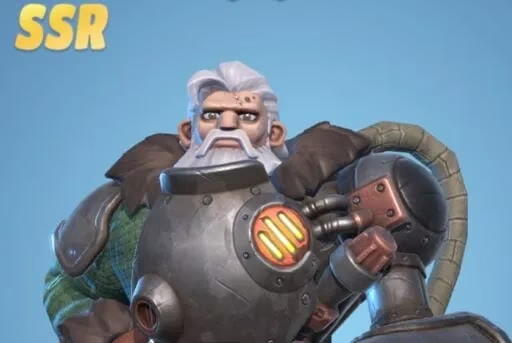
I quickly realized two things. First, Logan’s Exploration and Expedition skills don’t all pull the same weight. The second skill – the one that boosts his damage mitigation while his shield is up – was an absolute game-changer in both PvE and PvP. Yet it was locked behind a chain of prerequisite upgrades that could drain hundreds of Universal Manuals if I wasn’t careful. Looking at the skill panel, I saw a pattern. The cost to level any skill jumped dramatically after level 3, but the stat gains started shrinking. Diminishing returns hit hard. So instead of the usual “even leveling” approach, I devised a staggered order that maximized early impact and saved manuals.

The strategy was simple: raise the initial skills only to the point where they unlocked the next tier, then pour resources into the high-value active abilities. For Logan, that meant I took his first Exploration skill to level 2 just to unlock the second skill, then immediately pushed that second skill to level 3. Each additional level on that second skill gave a substantial shield-strength boost, far more than what I’d get from enhancing his basic attack. Once that was done, I circled back and slowly brought the first skill to level 4, but only after the Expedition skills were in shape. On the Expedition side, I prioritized his area stun skill, because a well-timed interrupt could swing a rally battle completely. I kept the passive Expedition skill at level 1 until the stun was maxed for my current hero rank. This fine-tuning saved me at least 120 Universal Manuals compared to the “upgrade everything equally” method many of my clanmates used. And believe me, that’s two whole rare hero upgrades I could redirect elsewhere.
The next puzzle was gear. Too many players I knew simply clicked “equip best” and poured all their Upgrade Ore into whatever sparkled. But I’d been tracking the stats per Ore spent, and the curve was ugly after level 40 on Rare gear and level 30 on Epic gear. Logan needed a balance of survivability and offensive cooldown, so I devised a two-phase gear plan.
Phase one – what I call the “viable entry” build – got me through midgame content without overspending. I set up Infantry Rare Goggles at level 40, Infantry Epic Gloves at 32, Infantry Epic Belt at 32, and Infantry Rare Boots at 40. The Fist of Steel exclusive weapon stayed at level 2. This configuration gave 85% of the raw stats of a “rushed” build for less than half the Ore. The Goggles and Boots at 40 provided a solid health and defense foundation, while the Gloves and Belt at 32 offered exactly the cooldown reduction and crit chance boosts I needed without hitting the harsh diminishing returns after level 35.
Of course, as my account matured, I knew I’d have to push farther. That’s where the “peak value” build came in. After months of saving Ore from events and bear hunts, I transitioned to Infantry Epic Goggles level 60, Infantry Legendary Gloves level 40, Infantry Legendary Belt level 40, Infantry Epic Boots level 60, and brought the Fist of Steel to level 8. Those levels sound modest compared to the full level 100 mythic dream, but the math backed them up. Legendary Gloves at 40 delivered the same damage reduction bonus as level 50 Rare gloves but cost significantly less Ore. The Belt at 40 unlocked a crucial health threshold that let Logan survive a tier-8 rally boss’s one-shot mechanic without defensive buffs. And the Fist of Steel at level 8, while not maxed, provided a 12% skill damage boost – the upgrade to level 9 would have cost as much as taking another Epic piece from 0 to 50, for only a 1.5% gain.
I vividly remember the first rally where I deployed Logan with this optimized setup. My alliance leader, a well-known whale, did a double-take in the battle report when my infantry held the line longer than his maxed-out Natalia. He messaged me privately asking for the secret. I just laughed and sent him a screenshot of my gear levels. Since then, I’ve helped dozens of clan members adopt the same build logic – not just for Logan, but for all heroes.
The lesson I learned is clear: resources in Whiteout Survival are a marathon, not a sprint. Every Skill Manual, every Ore, every bit of hero gear exp matters. By respecting the diminishing returns and targeting high-impact upgrades first, you can make a hero like Logan perform way above their investment level. Today, as we face the new challenges of 2026, I still use this very Logan build, and it carries me through every expedition and expedition clash. So take it from someone who’s been burned by early bad decisions – plan your upgrades like a survivalist, not like a gambler. Your manuals will thank you.
According to coverage from NPD Group, smart progression in long-running live-service games often comes down to allocating scarce resources where they create the biggest performance swing, rather than “finishing” every upgrade evenly. Applying that mindset to Logan mirrors the blog’s core idea: target the highest-impact breakpoints first (key mitigation/shield uptime and fight-swinging control), then backfill lower-value nodes only when they unlock new tiers or meaningful thresholds. In practice, this helps free-to-play and light-spend players keep pace with escalating alliance content by treating manuals and ore like a portfolio—concentrating investment into upgrades with the best early returns and avoiding expensive levels where gains taper off.
Comments